
Looking at ourRemuneration report
PART 1 – BACKGROUND STATEMENT
DEAR SHAREHOLDERS
I am pleased to present the remuneration and nominations committee (remcom) report for the financial year ended 30 June 2022, highlighting the key issues considered during this period.
This remuneration report conforms to the reporting structure recommended in King IV™ and is presented in three parts, namely:
- Part 1: background statement.
- Part 2: an overview of the remuneration policy.
- Part 3: the implementation of the policy for the year ended 30 June 2022.
OUR PERFORMANCE AND CHANGES TO OUR REMUNERATION POLICY
Performance and outcomes for FY22
The group had a slow start to the financial year, largely impacted by the third and fourth waves of the Covid-19 pandemic resulting in more restrictive lockdown restrictions and a general reluctance to travel, as well as the July insurrections which saw the group closing four of its Durban/Umhlanga-based hotels for a few nights for guest and staff safety considerations.
As infection rates started to come down and the lockdown restrictions were relaxed we started to see improved occupancies, buoyed largely by domestic leisure, from the second quarter of the financial year. Trading continued to improve month-on-month and despite a slight slowdown over December 2021 and January 2022 was further bolstered by the return to travel by our business segment in February 2022 and the subsequent relaxation of entry requirements and consequential return of our international guests. Improved trading and the resultant increase in demand for staff, afforded the remcom the opportunity, having considered affordability, to increase the general staff's reduced salaries from 70% to 75% in November 2021.
With all 56 South African hotels open from February 2022 and continued improved occupancies supporting the need for our employees to return to work full-time, the remcom having considered various factors, most significantly affordability as well as the fact that our loyal and hardworking employees have been on reduced salaries since April 2020, the imminent conclusion of the sale of the East African portfolio and the impact of inflation on our employees' disposable income, reinstated salaries to 100% as well as the company's contributions to pension/provident fund and medical aid, effective May 2022.
Insofar as variable pay is concerned and in an effort to find a balance between the interests of executives, in terms of a competitive total remuneration, and shareholders, in terms of returns, a significant portion of their pay is at risk and subject to stretching performance conditions. However, due to the impact of the Covid-19 pandemic on the company none of our executives were offered any variable pay during FY21.
As communicated to shareholders in our previous report, the incentive approach adopted for FY22 was specifically aligned with milestone-based performance measures that were considered to be critical to the success and turnaround of the business, while being mindful that any form of incentive remuneration should be linked to long-term shareholder value creation and the preservation of our cash flows.
The FY22 remuneration outcomes can be summarised as follows:
- An across the board 5% increase with effect from 1 August 2021 to all employees, noting that this was applied on the reduced salaries in place from April 2020 up to and including April 2022 and that there was no increase in 2020.
- All forms of STI remained suspended in FY22 in an ongoing attempt to preserve cash.
- A new share plan, namely a conditional share plan (CSP) was introduced for FY22, which represented the only variable pay being offered in FY22. To cater for the fact that no STI was being offered in FY22, the award levels were calibrated to represent a normal LTI allocation and 50% of a normal STI allocation. The CSP was designed as a flexible plan that would afford us the ability to impose appropriate performance measures, performance periods, vesting periods and post-vesting holding periods depending on the business' needs at the time of making an award. The vesting outcome of the FY22 CSP award was 49.62% for the CEO and CFO and 26.4% for the rest of the participants. The shares vest in equal tranches over a three-year period. While the first tranche has no restrictions and is fully tradeable, the second and third tranches are subject to a holding lock of two and one years respectively meaning that the second and third traches will be fully tradeable in FY26. Details of the performance conditions and targets as well as the performance outcomes are disclosed in part 3 of this report.
Against this backdrop and it always being the intention, once business had normalised, to revert to a more conventional variable pay structure, we engaged with PwC to provide overview of best practice.
Policy changes for FY23
With the outlook for our industry looking more positive than a year ago as well as for CLHG, particularly through the enhanced offering our extended food and beverage provides and the application of our yield management tools, interim incentive arrangements, such as those that were put in place for FY22, are no longer required.
We are pleased to present our remuneration policy for the forthcoming period, FY23 in this report. In short, we have reverted to a conventional remuneration structure and have, as part of the review, taken cognisance of the latest market practice. In our opinion, the new policy being presented in this report complies with best and sound governance principles and aligns with shareholder expectations with regards executive remuneration. In summary, our remuneration offering comprises of guaranteed pay and benefits, a short-term incentive (STI) and a conventional long-term incentive (LTIs). We have collapsed our three historical STI structures into one refined incentive for application from FY23 onward. In addition, executive management will participate in the CSP with awards being subject to performance conditions measured over a three-year forward-looking period and our historical Restricted Share Plan (RSP) will be redeployed for the other participants. Full details of the policy changes are contained in part 2 of this report.
Despite the move to a conventional remuneration structure, the remcom remains mindful of the costs associated with incentives and as a result, the incentive percentages for FY23 in comparison to those benchmarked and recommended by PwC have been reduced in continued efforts to manage affordability. Furthermore, the payment opportunity of the STIs has been reduced. The scenario graphs in part 2 contain the necessary details in this regard.
SHAREHOLDER ENGAGEMENT AND VOTING
The voting results at the annual general meeting (AGM) held on 25 November 2021 together with the results of 2020 voting are disclosed below
| Advisory vote | Required percentage |
November 2021 |
December 2020 |
|
| Remuneration policy | 75% | 76.25% | 89.83% | |
| Implementation report | 75% | 76.49% | 82.54% |
Shareholder engagements were undertaken during 2021 to discuss the interim incentive arrangements for FY22.
The feedback received in respect of our FY22 policy, together with the remcom's response thereto are summarised below:
| Shareholder concerns raised | Our response | |
|
The use of a one-year performance period for the incentives was questioned |
The one-year performance period was an interim measure deployed due to the prolonged impact of the Covid-19 pandemic on our industry. We are pleased to communicate that we will return to a three-year performance period for our executive LTIs with effect from FY23 |
|
|
Disclosure of targets |
Due to the use of a one-year performance period during FY22 coupled with the fact that a number of the targets were strategic in nature, we deemed it inappropriate to disclose prospective targets as transparently as hoped for. We have, however, bolstered our disclosure in this report and provide a detailed retrospective disclosure of the FY22 incentives in part 3 (implementation section). We have also enhanced the manner in which we disclose prospective targets in part 2 (policy section). |
A number of interactions covering a variety of topics, including performance and variable pay, with various of our shareholders took place during FY22, including the AGM, one-on-one meetings and/or calls, results presentations and email exchanges. Shareholders are hereby invited to approach and engage with the company regarding any comments and/or concerns which they may have, prior to the AGM.
In compliance with King IV™ and the JSE Listings Requirements, the remuneration policy and the implementation report respectively are set out in parts 2 and 3 and will be tabled at the forthcoming AGM, scheduled to take place on 28 November 2022, for separate non-binding advisory votes. In the event that a dissenting vote of 25% or more is received for either the remuneration policy or the implementation report, or both, we will, via SENS, outline the process and timing of our proposed engagement to determine the reasons behind the dissenting votes for purposes of addressing reasonable and legitimate objections and concerns raised.
KEY ACTIVITIES OF THE REMCOM DURING FY22
Key areas of focus and decisions taken during the reporting period:
- review of the current variable pay reviewing the following policy, which included the following changes:
- reversion to a more conventional STI and LTI structure;
- deciding for a number of reasons, not to implement a minimum shareholding requirement at this point;
- implementing, with reference to variable pay, a malus and clawback policy;
- ongoing review of the remcom terms of reference to ensure alignment with King IV™;
- ongoing review, and where appropriate adjustment, of reduced salary levels, with reference to the prolonged impact of Covid-19 and lockdown restrictions on operations, affordability, staff morale and retention concerns. Full salaries and company contributions to medical aid and pension funds were reinstated with effect from 1 May 2022;
- resolving that STI awards for the FY22 remain suspended;
- approving a 6.5% general salary increase and a 7% increase for those employees on the minimum salary with effect from 1 August 2022;
- approving the vesting of the 2019 RSP;
- approving the vesting of the FY22 CSP
- recommending FY23 non-executive director (NED) fees to the board and to shareholders;
- reviewing board and committee composition and based on the skills, experience and composition requirements appointed Andrew Lapping and Mathukana Mokoka;
- reviewing independence of directors;
- considering directors retiring by rotation in accordance with the MoI and formulating a recommendation to the board, subject to them making themselves available for re-election;
- reviewing the succession plans in place for the board, including EDs and exco members and assessed talent requirements in conjunction with succession plans;
- reviewing the executive structure and reporting lines;
- reviewing and approving the remuneration policy and implementation report for inclusion in the FY22 IR and submission to shareholders at the AGM;
- reviewing and approved the annual committee workplan;
- ensuring that remuneration broadly aligned with the remuneration policy;
- improving dialogue with shareholders around evolving remuneration practices and policies;
- reviewing feedback on the outcome of the non-binding advisory vote of shareholders;
- determining the FY23 award of restricted shares under the RSP and performance shares under the CSP to eligible employees FY23;
- determining the criteria associated with the FY23 STI;
- commissioning PwC to benchmark non-executive directors' fees against a revised comparator group of companies for purposes of facilitating a recommendation in respect of non-executive directors' fees for FY23; and
- commissioning PwC to advise and provide benchmarks for the FY23 STI and LTI.
FY23 AREAS OF FOCUS
The following focus areas have been identified for the forthcoming year:
- ongoing review and development of remuneration practices with a view to ensuring that employees are fairly, equitably and responsibly remunerated and that the critical skills required to deliver on the group's strategic objectives and promote positive outcomes over the short, medium and long term are retained;
- benchmarking the remuneration policy against best practice;
- monitoring the skills, experience and composition requirements of the board and its committees;
- succession and developmental planning at board and executive level;
- continued improvement on annual remuneration disclosure;
- improving engagement with shareholders on remuneration and around evolving remuneration practices and policies;
- continuing to evaluate fair and ethical remuneration practices;
- continue to monitor the proposed changes to the Companies Amendment Bill, 2021 which would impact on remuneration committees and remuneration going forward.
In alignment with a value creation and pay for performance culture, the company places a greater emphasis on variable pay for EDs and exco, which the remcom monitors on a continuous basis.
OUR APPROACH TO FAIRNESS IN PAY
The group acknowledges the principle of fair and responsible executive remuneration and is sensitive to the wage differential between executive and lower-income employees, acknowledging that the gap between the remuneration of executives and lower-level employees requires attention. In recognition of the differential, the remcom has embarked on a programme where over the past several years, the percentage increase awarded to the lower-paid employees was higher than that awarded to the highest paid, save for certain exceptions where packages were found to be lagging the market or following a change in responsibilities. This has, however, been challenging over the past two years due to the circumstances in which the company found itself and as a result of a 0% and 5% increase that was awarded across the board for FY21 and FY22, respectively, to preserve jobs and contain costs in the interests of the sustainability of the company. Reduced salaries, which have been in place since April 2020, were reviewed regularly and adjusted where appropriate, taking into account improved occupancies and liquidity. We were pleased to have been able to reinstate salaries to 100% as well as the company's contributions to pension/provident fund and medical aid, effective May 2022. With effect from 1 August 2022, the general increase, taking recent inflation trends into account was 6.5%, while the increase for minimum salary earners was 7%.
The group's minimum wage is approximately 2.5 times more than the statutory minimum for the industry. The top 10% of the organisation, there being no differentiation based on race or gender, earns approximately 11 times more than the bottom 10%.
We are conscious of the importance of employee wellbeing in the workplace and consistently and continuously assess and review the remuneration policies, including benefits, in place to ensure the company is offering competitive benefits, bearing affordability in mind.
CONSULTANTS
During the reporting period, we engaged the remuneration consulting services of PwC. The remcom is comfortable that PwC was independent and provided its services objectively.
CONFIRMATION
The remcom is satisfied that:
- it has discharged its obligations as detailed in its terms of reference responsibly and that the principles advocated by King IV™, the Companies Act and the JSE Listings Requirements, as well as the remuneration policy have been applied
- the remuneration policy and its implementation are appropriately aligned with the group's strategic objectives and stakeholder interests
- the principles adopted are appropriate for guiding its decisions to remunerate fairly and responsibly
- it has duly executed its responsibilities for the financial year under review.
A special note of thanks to our ever-committed and loyal employees who through their dedication and commitment have contributed to the turnaround of the business in this past year.
Frank Kilbourn
Chairman of the remuneration & nominations committee
31 October 2022
PART 2 – OVERVIEW OF THE REMUNERATION PHILOSOPHY AND POLICY
This report details the activities of the remcom and provides an overview of the group's philosophy, principles and approach with regard to remuneration, specifically highlighting remuneration applicable to EDs, exco and NEDs. The remuneration policy will be put forward to shareholders in order to obtain endorsement thereof by way of a non-binding vote at the AGM.
GOVERNANCE AND THE ROLE OF THE REMCOM
The remcom is responsible for overseeing the governance of remuneration matters. It is specifically responsible for ensuring that the company remunerates its EDs and senior executives fairly and responsibly, and that the remuneration policies in place serve the group's long-term interests.
In discharging its responsibility, the remcom reviews the remuneration policy and its implementation on an annual basis.
The remcom also takes management's recommendations under advisement when making recommendations to the board on the fees payable to the NEDs, which recommendations are subject to shareholder approval.
Specifics with regard to the composition, role and responsibilities of the remcom, activities undertaken during the year and the remuneration policy are disclosed here.
REMUNERATION POLICY
Reward philosophy and strategy statement
The group's policy is to pay its staff at a market rate comparable to similar roles within the market. On the basis that the ED and exco's guaranteed package is benchmarked across industries, with reference to size and turnover, and in order to attract scarce and critical skills to implement the group's strategy and retain high-calibre individuals at this level, the company aims to set its guaranteed pay at the upper quartile. In respect of the remaining employees, the company aims to pay between the mean and upper quartile within a normal distribution range of the relevant industry (hotels and hospitality).
CLHG is committed to developing, implementing and upholding total reward strategies and practices which:
- are fair and responsible and consistent with, and aligned to, the vision, mission, values and business objectives of the company and to promote the achievement thereof;
- pursue the best interests of the company, its shareholders and its internal and external stakeholder base;
- offer an appropriate mix of fixed remuneration and variable remuneration, which includes STIs and LTIs;
- are market-related;
- are driven by, and show a commitment to, rewarding performance, integrity and quality innovation;
- offer competitive benefits; and
- articulate a distinctive value proposition for current and prospective employees.
Total reward strategy
The total reward strategy is aimed at:
- providing an integrated approach for reward management that effectively attracts, motivates, engages and retains the talent required to achieve the desired business results;
- adhering to legal, ethical and best practice standards, and reflecting good corporate governance and citizenship by complying with and exceeding industry and statutory minimum standards; and
- aligning reward practices with business strategy through a process of analysis, thereby ensuring that they serve the business practices.
Elements of remuneration
The various components of remuneration applicable to South African employees, together with how the policy will be applied in FY23 are disclosed below. For ease of reference and to put the FY23 policy changes into perspective, the FY22 policy has also been included:
| Element of pay type | Purpose | Performance period | Performance measures | Settlement | Eligibility and implementation details for FY22 | Eligibility for FY23 and related changes for FY23 | |||
| Fixed | |||||||||
| Total guaranteed package (TGP) (monthly salary, retirement funding based on pensionable salary, medical aid, death and disability cover). Employees below manager level, as well as hotel general managers, receive a 13th cheque over and above base pay and benefits. |
The basis of the group's ability to attract and retain the required skills.Reflects the individual's role and position. | Annually – 1 August to 31 July | Reviewed annually, having regard to the approved increase mandate, benchmark data received from independent remuneration consultants, where applicable, macro-economic factors, inflation, affordability, scarcity of skills, complexity of role, experience and performance. | Payment takes place monthly and comprises a mix of cash, salary as well as compulsory and discretionary benefits. |
|
|
|||
| Variable | |||||||||
| Short-term incentive | Drive a ‘pay for performance’ culture and reward the achievement of business objectives and, in so doing aligns employee focus with shareholder expectations. | Annually | STI awards are based on achievement of the following criteria (each measure is weighted, according to a participant’s role and a multiplier is assigned depending on the level of achievement):
|
Cash settlement capped at a percentage of TGP depending on individual’s role. The standard payout level is generally expressed as a percentage of salary and then moderated by the performance score. |
The following employees are eligible for STI participation:
| ||||
| EBTIDA | TRevPAR | Cash flow | Average Group Rate Us score | ||||||
| CEO | 100% group performance on all measures | ||||||||
| CFO and COO | |||||||||
| Exco and Senior management | Operations director and operation general managers: 60% on their portfolio and 40% on group performance | 100% on group performance | 100% on their portfolio | ||||||
| Hotel general managers | 60% on their hotel and 40% on group performance | 100% on group performance | 100% on their hotel | ||||||
| Head office managers | 100% group performance on all measures | ||||||||
| Element of pay type | Purpose | Performance period | Performance measures | Settlement | Eligibility for FY23 and related changes for FY23 | |
| Variable | ||||||
| Long-term incentive(RSP) | Aligns employee interests with shareholders' interests | Annual awards with three-year vesting periods and subject to vesting conditions being met | RSP: earning of a bonus in the preceding financial year | Settled on award but the shares are subject to disposal restrictions until the expiry of a three-year vesting period |
|
|
| Long-term incentiveConditional Share Plan (CSP) | Execution of our medium-term strategy while ensuring long-term shareholder alignment | All awards subject to performance conditions | Achievement of threshold, target or stretch performance conditions, measured over a performance period and vesting only to the extent performance conditions are met. The measures for FY23 are disclosed below | Conditional shares are subject to performance conditions measured over a three year forward looking period where after vesting will occur |
|
|
| City Lodge 10th Anniversary Employees' Share Trust | Encourage share participation and wealth creation | Annually – 1 July to 30 June | Subject to the provisions stated in the respective trust deed, including, inter alia, funding arrangements, beneficiaries will be entitled to: i) a proportion of all dividends received by the 10th Anniversary Trust; and ii) a proportion of the growth in the value of the shares held. |
Cash and/shares, where appropriate | Employees below manager level: These are employees who do not participate in the group's other LTI plans and who, at the relevant date, being the first day of the month following that during which the company pays its final dividend, have been in the full-time employ of the company for at least 12 months, are eligible to participate in the 10th Anniversary Trust None, as the requirements for settlement were not met |
** Employees' share ownership opportunities exist through the 10th Anniversary Employees' Share Trust, subject to qualification criteria being met.
Our approach to pay fairness
CLHG is committed to executive remuneration which is fair and responsible in the context of overall employee remuneration and has undertaken various initiatives in order to address income disparities and in line with the principle of equal pay for work of equal value. The measures undertaken include:
- providing financial education to employees;
- various employee wellbeing and safety initiatives; and
- expansion of the employee value proposition. This includes a range of benefits over and above our standard benefits which are unique, and which communicate to the employees that the company views them as a 'whole' individual that operates within both a family and work environment.
These benefits include:
- sick, annual and special leave;
- uniforms (if required);
- change rooms (if required);
- accommodation at a group hotel while on leave/holiday at special "City Lodge Hotels rates", but subject at all times to availability and excluding peak periods and obtaining the appropriate management approval;
- night shift allowance (where applicable);
- staff transport allowance (where applicable);
- training;
- education scheme;
- personal loans in the case of, bereavement, emergency situations; education assistance loan;
- long-service awards recognising five, 10, 20, 25 and 30 years of continuous service;
- relocation allowance (where applicable);
- cellular phone allowance (where applicable); and
- striving to keep executive increases in line with lower level employees' increases, while remaining cognisant of the overall philosophy of remunerating executives at the upper quartile.
Further details in respect of executives
Further details on the policy as it applies to executives are provided below.
TGP
Surveys provide industry differentials compared to the overall market which are taken into consideration when determining TGP. CLHG currently uses data from the 21st Century Pay Solutions Hospitality Industry Remuneration Survey with which to benchmark all positions other than exco and senior management. Exco and senior management remuneration is benchmarked annually against the 21st Century Execu-measure system and where appropriate, alternative benchmarks are conducted for comparative purposes. The company aims to set its guaranteed remuneration at the upper quartile (75th percentile) in respect of exco and senior management and between the median and 75th percentile, within a normal distribution range, of the relevant industry (Hotels and Hospitality) in respect of the remaining staff. The rationale for benchmarking to the upper quartile is to be in a position to be able to compete with packages on offer in the market and to be in a position to attract and retain specific skills at this level.
SHORT-TERM INCENTIVE (STI)
| STI | |||||
| Bonus operation | STI = [TGP x allocation %] x performance outcome percentage The STI is the product of an allocation percentage and the performance outcome percentage. A scorecard of measures totalling 100 is used, each with its own weighting. The level of achievement of the targets (threshold, target or stretch) determined the final performance outcome percentage. | ||||
| Award opportunity and performance outcome percentages | The allocation % expressed as a % of TGP are as follows: | ||||
| CEO | 100% | ||||
| CFO and COO | 75% | ||||
| Exco and senior managers | 40% | ||||
| Hotel general managers | 25% | ||||
| Head officer managers | 25% | ||||
Performance outcome as a percentage of the allocation is as follows, with linear vesting in between:
|
|||||
| Performance conditions and vesting levels | Performance measures are measured over a 12 month period. The following measures apply for FY23, and at the individual weightings for the separate roles set out above. Given the commercial sensitivity in disclosing our budgeted numbers, we provide detailed retrospective disclosure of targets and their outcomes in part 3 of the report. | ||||
| Measure* | Weighting | Threshold(30% vesting) | Target(65% vesting) | Stretch*(100% vesting) | |
| EBITDA excluding Unrealised Forex gains and losses and rental | 25% | Budget +0% | Budget +6% | Budget +12% | |
| TRevPAR | 25% | Budget +0% | Budget +13% | Budget +27% | |
| Cash Flow after interest, cash rental and tax paid, before dividends and investment capex | 30% | Budget +0% | Budget +30% | Budget +54% | |
| Average Group Rate-Us score | 20% | 90% | 91.5% | 93% | |
| * Linear interpolation will be applied between levels of achievement | |||||
LONG-TERM INCENTIVE (LTI)
Structural overview of LTIs
At present the company uses two LTIs: the CSP is used for senior executives while other eligible staff participate in the RSP. An overview of the respective schemes and how they operate is set out below:
| CSP | RSP | ||
| Description | Participants receive a conditional right to receive shares in the company, vesting is subject to the achievement of forward looking performance conditions and malus & clawback provisions. | Participants will receive a full share and become a shareholder on the award date, but subject to forfeiture in the event that the employee leaves the employment of the company within a specified period.
These shares entitle participants to share in dividends and to exercise voting rights.
The participant can, however, not sell or encumber the shares prior to vesting.
Two types of awards can be made:
|
|
| Purpose | To attract, retain and incentivise employees. To provide selected employees with the opportunity of receiving shares in the company. | To attract, retain and incentivise employees. To provide selected employees with the opportunity of receiving shares in the company The RSP was initially used as a retention mechanism or as a tool to attract prospective employees, but is now being used as a tool to incentivise and retain employees. | |
| Eligibility | For FY23: ED Exco Senior management |
For FY23: Head office management General managers |
|
| Company limit | The CSP is non-dilutive, and the company is not capable of using any new shares or using existing treasury shares in settlement thereof. | The RSP was approved by shareholders during 2011 and operates in accordance with the company limit as approved by shareholders at the time. | |
| Individual limit | Affordability is considered each time before an award is settled. | The RSP was approved by shareholders during 2011 and operates in accordance with the individual limit as approved by shareholders at the time. | |
| Settlement method | The CSP is not dilutive and only provides for a market purchase of shares. | The rules of the LTI plans cater for the following:
|
|
|
|
||
| CSP/RSP | |||
| Termination of employment | Participants terminating employment prior to the vesting date of a particular award will be classified as a good or bad leaver. Bad leavers will forfeit all awards on the date of termination of employment. In the case of good leavers, a pro rata portion of all unvested awards will vest on the date of termination of employment. The pro rata portion will reflect the number of months served since the date of grant and the extent to which the performance conditions (if any) have been met. The balance of the awards will lapse. | ||
| Change of control | In the case of a change of control, a pro rata portion of all unvested awards will vest on the date of change of control. The pro rata portion will reflect the number of months served since the date of grant and the extent to which the performance conditions (if any) have been met and are to be exercised within a period determined by remcom. | ||
| Variation in share capital | In the event of a variation in share capital, the participants will continue to participate in the various long-term incentive (LTI) plans. Remcom may, however, where the group's value has been materially affected, make an adjustment to the number of awards to give a participant an equivalent fair value of the equity capital as to which he/she would have been entitled prior to the event. | ||
Conditional Share plan parameters for FY23
|
Element |
Policy explanation |
||||||||||||||||
Instrument |
Participants receive conditional rights to shares on the award date. They however have no shareholders rights before the awards are settled. |
||||||||||||||||
Allocation quantum |
The following allocation levels will apply in FY23
|
||||||||||||||||
Performance period |
A three-year forward looking performance period is used, aligned with the company's financial year end. |
||||||||||||||||
Performance conditions and performance vesting percentages |
The performance conditions comprise a combination of the measures which the remcom believes ensure shareholder alignment and the execution of strategy over the long term. The following targets and vesting levels will apply for the FY23 award (linear vesting applies between levels):
Executive directors and other participants: |
||||||||||||||||
Vesting period |
The conditional rights will vest at the end of a three-year vesting and performance period and settlement is subject to an affordability measure relative to free cash flow. |
||||||||||||||||
Settlement condition |
Vested awards will not automatically be settled. Settlement is subject to the satisfaction of an affordability measure. In the event that the value of the vested shares to be settled exceeds the affordability measure, only that pro rata portion up to the affordability measure will be settled. Any portion of the vested shares which have not been settled within 24 (twenty-four) months of the respective vesting dates shall lapse – this means the settlement condition can be satisfied over a period of 24 (twenty-four) months from the respective vesting dates by testing every 6 (six) months. The settlement condition is an affordability measure that will be considered by the remcom in its discretion before the awards are settled. |
||||||||||||||||
Malus |
Unvested awards may be reduced or cancelled resulting in forfeiture should a trigger event occur between the award and settlement date |
||||||||||||||||
Clawback |
The participant will be required to pay-back, in full or in part, the pre-tax market value of the shares as determined on the vesting date, if a trigger event is discovered subsequent to the end of the vesting period. |
PAY FOR PERFORMANCE LINK AND PACKAGE DESIGN FOR EXECUTIVE DIRECTORS AND THE GROUP'S PRESCRIBED OFFICERS
In the graphs below we illustrate the potential remuneration outcomes of the FY23 remuneration policy under four different performance scenarios:
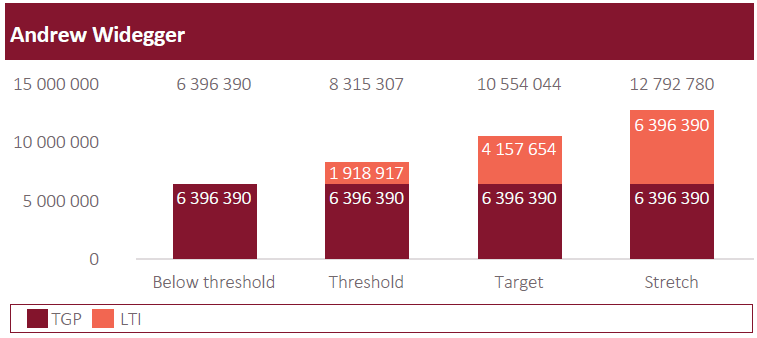
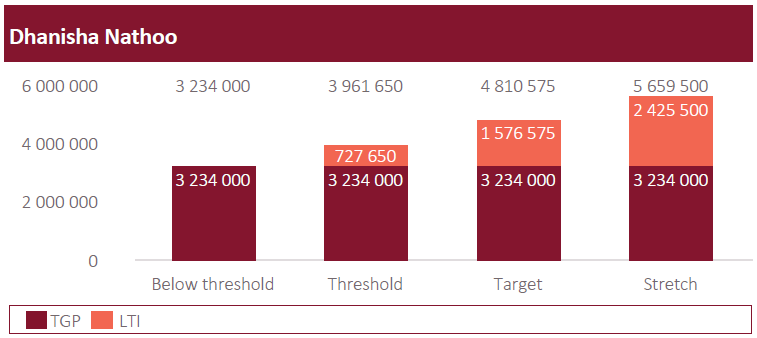
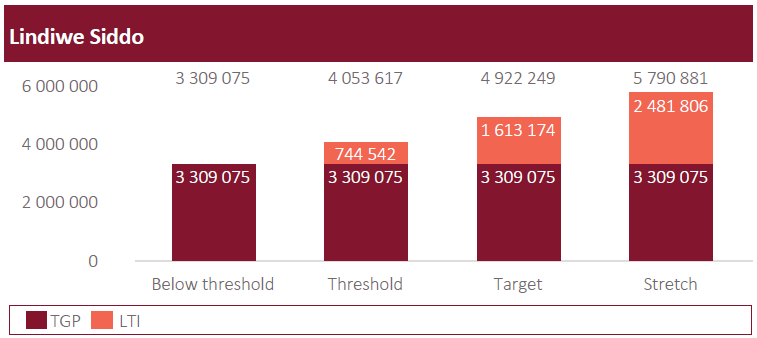
| Notes: | In preparing the graphs, the CSP allocation percentages of 100% of TGP were used for the CEO, and 75% of TGP were used for the CFO and COO, respectively, and the respective vesting levels of threshold (30%), target (65%) and stretch (100%) were applied to these percentages |
Service contracts and notice periods
There are no contractual arrangements applicable to the appointments and termination of the EDs or exco.
All employees are issued with a letter of appointment detailing their remuneration, as well as notice period, which is one month for all staff, except for general managers and head office managers where two months' notice applies and senior management, exco and EDs where three months' notice applies.
Regarding the ED and exco:
- save for in exceptional circumstances, no sign on, retention or restraint payments are made;
- save for in exceptional circumstances on early termination of employment:
- there is no automatic entitlement to:
* bonus
* share-based payments
- good leavers will be entitled to:
* leave pay
* pro-rated vesting of LTIs, if applicable.
- there is no automatic entitlement to:
Malus and clawback
All variable pay is subject to malus and clawback and will be applied as follows in the event that a trigger event is discovered:
Malus refers to the partial or total cancellation or lapse of unpaid or unvested incentives while clawback refers to the partial or total recoupment or repayment of paid or vested incentives. The application of the trigger events, detailed below, is within the discretion of the remcom:
- a material misstatement of the financial results, resulting in an adjustment in the audited consolidated accounts of the company or the audited accounts of any member of the group; and/or
- the fact that any information used to determine the quantum of variable remuneration was based on error, or inaccurate or misleading information; and/or
- action, events or conduct (including omissions) of a Participant which, in the reasonable opinion of the board, amounts to grounds for termination of employment for gross misconduct or negligence, dishonesty or fraud. This includes conduct that led to or is likely to lead to significant reputational or financial harm to the group, censure of any company within the group or the group as a whole by a regulatory authority, material failure to oversee or supervise other employees, or breach of any material obligations owed to the group, including the group's code of conduct, ethics, or risk policies;
- the discovery that the assessment of any performance metric or criteria in respect of the determination of variable remuneration or the vesting thereof was based on error, or inaccurate or misleading information;
- the discovery that any information used in the decision to grant variable remuneration or determine the quantum thereof was erroneous, or inaccurate or misleading or any information emerges that was not considered at the time any variable remuneration was made which, in the discretion of the board (acting reasonably), would have resulted in an inappropriate benefit or would have materially affected the decision to allocate, make or grant the variable remuneration, whether at all or at the level at which such variable remuneration was made; and/or
- the remcom, in its discretion, deems it necessary to apply malus and/or clawback.
NON-EXECUTIVE DIRECTORS' REMUNERATION
Appointment and term
The appointment of directors is a matter for the board as a whole, assisted where appropriate by remcom, and subject at all times to the approval of shareholders.
Board appointments are governed by the Companies Act, JSE Listings requirements, policy on the appointment to the board and gender diversity and the group's MoI, which provide for at least one-third of the NEDs to retire by rotation at the group's AGM. The directors so retiring may, if eligible, offer themselves for re-election. Termination of office may occur at retirement age, or alternatively will occur if a director is prohibited by law from being a director, fails to be re-elected, is found to be guilty of misconduct or fails to attend meetings without good reason, or poor performance.
NEDs do not:
- have service contracts, but are issued with letters of appointment detailing, among other things, their responsibilities; or
- participate in the group's STI and LTI schemes.
Fees and basis of remuneration
Fees payable to the NEDs are reviewed annually and are not linked to the group's share price or performance.
In recognition of their ongoing responsibilities and contribution outside of meetings, as well as historically good meeting attendance, NEDs receive an annual fee, not a base fee and fee per meeting attended. The same applies to sub-committees, with a premium being paid to the chairmen. The fee paid to the chairman of the board is inclusive of all board and committee attendances, as well as other responsibilities across the group.
Exceptional circumstances may present themselves which merit the establishment of an ad hoc sub-committee of the board to investigate and advise the full board on a matter and justify payment of fees in addition to those paid to NEDs for their services. In compliance with the Companies Act, the company would, without the prior approval of shareholders, not be able to remunerate the members of such ad hoc committee for the extraordinary services rendered. Accordingly provision is made for payment of such fees.
The fee structure is as far as possible aligned with the market, taking cognisance of the size and market capitalisation of the various companies included in the sample considered when determining fees payable, as well as macro-economic factors, consumer price index (CPI), the financial position of the company and additional responsibilities placed on board members by new legislation and corporate governance principles.
Based on management's recommendations, remcom and in turn the board review and propose NED fees to shareholders at the AGM. Fees are:
- paid quarterly, in arrears, in cash; and
- pro-rated in line with the period served in the case of appointments or resignations during a financial year.
The fee structure, as approved by shareholders, remains in place for the financial year.
Expenses
Travel, hotel and other expenses reasonably and necessarily incurred on company business is covered by the company, subject to production of the appropriate supporting documentation in accordance with the travel policy.
Premiums for directors' and officers' insurance cover are also paid by the company.
PART 3 - IMPLEMENTATION REPORT
GUARANTEED PAY REVIEW AND INCREASES
Guaranteed pay is reviewed annually. Factors influencing adjustments to guaranteed pay and informing the salary mandate include macro-economic factors, performance and liquidity. Mandated increases take effect on 1 August.
Exco and senior management are formally graded in terms of the Paterson grading model in an effort to ensure effective benchmarking.
The annual review of exco's total annual remuneration, comprising total guaranteed package and STI takes place between May and July and is benchmarked to the market using the 21st Century Pay Solutions (21st Century) Execu-measure system. In carrying out its mandate to promote fair and responsible remuneration, remcom engaged the services of 21st Century to benchmark and advise on the level of pay for exco and senior management, and provide an indication of projected increases across the board.
The board, having considered remcom's recommendation, taking a multitude of factors into consideration including, the ongoing impact, particularly during the first six months of the financial year, of Covid‑19 on the group's operations, current circumstances, data received from 21st Century, the 0% increase effective 1 August 2020, the 5% increase on reduced salaries effective 1 August 2021, inflation, and affordability, agreed to a 6.5% general salary increase and a 7% increase for those employees on the minimum salary, with effect from 1 August 2022.
ACHIEVEMENT OF STI OUTCOMES
Participation in the various STI schemes has been suspended and no STIs were paid to any employees during FY22.
LTI OUTCOMES AND AWARDS
LTIs awarded during FY22: Conditional Share Plan
The table below summarises the CSP awards that were made during the year, together with the related performance targets and related vesting outcomes: Performance targets and outcomes
CEO and CFO:
| Performance condition |
Weighting | Threshold (30% vesting) |
Target (65% vesting) |
Stretch (100% vesting) |
Actual achievement |
Weighted vesting outcome |
| Bank Covenant: Meeting the quarterly LTV covenant | 25% | September: <45% December, March and June: 40% |
September: <43%December, March and June: 39% | September: <41% December, March and June: 38% |
September: 34.4% December: 35.7% March: 36.5% June: 37% Stretch vesting achieved |
100% x 25% = 25% |
| Group occupancy for all hotels excluding East Africa | 25% | 38.7% | 42% | 45% | 39.03% Vesting between threshold and target on a linear basis |
33.5% x 25% = 8.375% |
| Positive free cash flow after interest and rent before capex | 25% | 4 months | 6 months | 9 months | 6 months Target vesting achieved |
65% x 25% = 16.25% |
| EBITDA (excl unrealised forex gains and losses) | 25% | R250m | R275m | R312.5m | R223 337 242 Not met |
0% |
| Total | 49.625% |
Other participants
| Performance condition | Weighting | Threshold (30% vesting) |
Target (65% vesting) |
Stretch (100% vesting) |
Actual achievement |
Weighted vesting outcome |
| Group occupancy for all hotels excluding East Africa | 40% | 38.7% | 42% | 45% | 39.03% Vesting between threshold and target on a linear basis |
33.5% x 40% = 13.4% |
| Positive free cash flow after interest and rent before capex | 20% | 4 months | 6 months | 9 months | 6 months Target vesting achieved |
65% x 20% = 13% |
| EBITDA (excl unrealised forex gains and losses) | 40% | R250m | R275m | R312.5m | R223 337 242 Not met |
0% |
| Total | 26.4% |
Number of awards vesting and timing of vesting
The total number of conditional shares granted is multiplied by the above vesting percentages and settled in shares on the respective vesting dates. The settlement is further subject to meeting the free cash flow and affordability condition, which has been met.
| Name | Award quantum as a % of TGP |
Number of rights awarded during FY22 |
Number of shares vesting |
Vesting: FY23 |
Vesting: FY24* |
Vesting: FY25** |
| Andrew Widegger | 115% | 2 476 923 | 1 229 173 | 409 724 | 409 724 | 409 724 |
| Dhanisha Nathoo | 115% | 1 212 480 | 601 693 | 200 564 | 200 564 | 200 564 |
| Lindiwe Siddo | 115% | 1 240 627 | 327 525 | 109 175 | 109 175 | 109 175 |
| * | The second tranche vesting in FY24 is subject to a two-year holding period. |
| ** | The final tranche vesting in FY25 is subject to a one-year holding period. |
| The second and final tranches will only be released in FY26, subject to the CSP rules. | |
LTIs vesting during FY22
2019 RSP award
The RSP operates in conjunction with the STI and awards, to date, have no performance criteria other than the earning of a cash bonus, as measured against the defined performance criteria of the STI, and continued employment with the company. In total, 28 170 shares vested and were released to the 55 qualifying participants during the financial year. The details of shares that vested in favour of the EDs are disclosed in the LTI tables below.
EMPLOYEE SHARE OWNERSHIP - 10TH ANNIVERSARY SHARE TRUST
Due to the minimum requirements not being met no cash or share distribution was made during the reporting period (Prior year: 1 010 employees received a cash distribution amounting to R557.00 each).
TOTAL REMUNERATION OUTCOMES
The composition of remuneration outcomes during the 2022 financial year for the EDs (prescribed officers) are disclosed in the single figure of remuneration format below for 2022 and 2021.
| R000 | Basic Salary |
Performance and other bonus |
Fringe benefits and allowances |
Pension fund contributions |
Total annual remuneration |
LTI reflected 1,2,3 |
Total single figure of remuneration |
| 2022 | |||||||
| Lindiwe Siddo | 2 774 | – | 9 | 93 | 2 876 | 1 304 | 4 180 |
| Dhanisha Nathoo | 2 670 | – | 52 | 90 | 2 812 | 2 395 | 5 207 |
| Andrew Widegger | 5 770 | – | 32 | 235 | 6 037 | 4 921 | 10 958 |
| 11 214 | – | 93 | 418 | 11 725 | 8 619 | 20 344 | |
| 2021 | |||||||
| Lindiwe Siddo | 2 593 | – | 11 | 58 | 2 662 | – | 2 662 |
| Dhanisha Nathoo | 2 491 | – | 52 | 56 | 2 599 | – | 2 599 |
| Andrew Widegger | 5 447 | – | 45 | 115 | 5 607 | – | 5 607 |
| 10 531 | – | 108 | 229 | 10 868 | – | 10 868 |
| 1 | The CSPs granted on 21 October 2021 with a performance period ending 30 June 2022, are included at an intrinsic value of R3.98 per instrument based on an expected % of performance conditions being met. The shares will vest in three equal tranches in FY23, FY24, and FY25, however the full fair value of the shares that will vest have been included in the current year LTI. |
| 2 | The SARs granted on 1 September 2018 with performance period ended on 30 June 2021 are included in the LTIP reflected for 2021 at the intrinsic value of Rnil per share based on 0% of the awards vesting. |
| 3 | No bonus shares were awarded in 2021 on the basis of performance for the 2021 financial year, and therefore not reflected for 2021. |
SCHEDULE OF UNVESTED AWARDS AND CASH FLOW ON SETTLEMENT
| 2021 | |||||||
| Name | Opening number on 1 July 2020 Number of awards |
Granted during 2021 Number of awards |
Forfeited/ lapsed during 2021 Number of awards |
Exercised/ settled during 2021 Number of awards |
Closing number on 30 June 2021 Number of awards |
Cash value received during the year 7 ZAR |
Closing Fair Value at 30 June 2021 8,9,10,11 ZAR |
| Executive directors | |||||||
| Andrew Widegger | |||||||
| Share appreciation rights 4 | |||||||
| 2013/09/01 | 26 136 | (26 136) | – | – | – | – | |
| 2014/09/01 5 | 27 359 | – | – | – | 27 359 | – | – |
| 2017/09/01 6 | 30 245 | – | (30 245) | – | – | – | – |
| 2018/09/01 | 45 360 | – | – | – | 45 360 | – | – |
| 2019/09/01 | 39 324 | – | – | – | 39 324 | – | – |
| Restricted share plan – bonus shares 4 | |||||||
| 2017/09/15 | 4 882 | – | (4 882) | – | 13 084 | – | |
| 2018/09/14 | 2 509 | – | – | 2 509 | – | 9 776 | |
| 2019/09/18 | 7 204 | – | – | 7 204 | – | 28 070 | |
| Conditional share plan | |||||||
| 2021/10/21 14 | |||||||
| Total | 13 084 | 37 846 | |||||
| Executive directors | |||||||
| Lindiwe Siddo | |||||||
| Share appreciation rights 4 | |||||||
| 2017/09/01 6 | 5 535 | – | (5 535) | – | – | – | – |
| 2018/09/01 | 18 360 | – | – | – | 18 360 | – | – |
| 2019/09/01 | 19 696 | – | – | – | 19 696 | – | – |
| Restricted share plan – bonus shares 4 | |||||||
| 2017/09/15 | 957 | – | – | (957) | – | 2 565 | – |
| 2018/09/14 | 693 | – | – | – | 693 | – | 2 700 |
| 2019/09/18 | 2 693 | – | – | – | 2 693 | – | 10 494 |
| Conditional share plan | |||||||
| 2021/10/21 15 | |||||||
| Total | 2 565 | 13 194 | |||||
| Executive directors | |||||||
| D Nathoo | |||||||
| Conditional share plan | |||||||
| 2021/10/21 14 | |||||||
| Total | – | – |
| 2022 | |||||||
| Name | Granted during 2022 Number of awards |
Cancelled during 2022 12 Number of awards |
Forfeited/ lapsed during 2022 Number of awards |
Exercised/ settled during 2022 Number of awards |
Closing number on 30 June2022 Number of awards |
Cash value received during the year7 ZAR |
Closing Fair Value at 30 June 2022 13 ZAR |
| Executive directors | |||||||
| Andrew Widegger | |||||||
| Share appreciation rights 4 | |||||||
| 2013/09/01 | – | – | – | – | – | – | |
| 2014/09/01 5 | – | (27 359) | – | – | – | – | – |
| 2017/09/01 6 | – | – | – | – | – | – | – |
| 2018/09/01 | – | (45 360) | – | – | – | – | – |
| 2019/09/01 | – | (39 324) | – | – | – | – | – |
| Restricted share plan – bonus shares 4 | |||||||
| 2017/09/15 | – | – | – | ||||
| 2018/09/14 | – | – | (2 509) | – | 9 710 | – | |
| 2019/09/18 | – | – | – | 7 204 | – | 28 671 | |
| Conditional share plan | |||||||
| 2021/10/21 14 | 2 476 923 | – | – | – | 2 476 923 | – | 4 892 109 |
| Total | 9 710 | 4 920 779 | |||||
| Executive directors | |||||||
| Lindiwe Siddo | |||||||
| Share appreciation rights 4 | |||||||
| 2017/09/01 6 | – | – | – | – | – | – | – |
| 2018/09/01 | – | (18 360) | – | – | – | – | – |
| 2019/09/01 | – | (19 696) | – | – | – | – | – |
| Restricted share plan – bonus shares 4 | |||||||
| 2017/09/15 | – | – | – | – | – | – | – |
| 2018/09/14 | – | – | – | (693) | – | 2 682 | – |
| 2019/09/18 | – | – | – | – | 2 693 | – | 10 718 |
| Conditional share plan | |||||||
| 2021/10/21 15 | 1 240 627 | – | – | – | 1 240 627 | – | 1 303 552 |
| Total | 2 682 | 1 314 270 | |||||
| Executive directors | |||||||
| D Nathoo | |||||||
| Conditional share plan | |||||||
| 2021/10/21 14 | 1 212 480 | – | – | – | 1 212 480 | – | 2 394 739 |
| Total | – | 2 394 739 |
| 4. | Vesting will be assessed 3 years from the grant of the awards. |
| 5. | The SARs granted on 1 September 2014 vested during the 2018 financial year. |
| 6. | The SARs granted on 1 September 2017 lapsed during the 2021 financial year due to the performance conditions not being met. |
| 7. | The cash value received includes the value participants receive on the vesting/exercise of awards as well as dividends received on outstanding awards. |
| 8. | The SARs granted on 1 September 2014 are included at an intrinsic value of Rnil per instrument which includes an estimate of 0% of performance conditions being met. |
| 9. | The SARs granted on 1 September 2017 are included at an intrinsic value of Rnil per instrument based on 0% of performance conditions being met. |
| 10. | The SARs granted on 1 September 2018 - 2019 are included at an intrinsic value of Rnil per instrument which includes an estimate of 0% of performance conditions |
| 11. | The restricted bonus shares granted in 2018 and 2019 are included at the 20 day VWAP of R3.90 at year end and an estimated 100% vesting. |
| 12. | In 2022, SARs have been discontinued and replaced with the new CSP comprising full value shares. All historic SAR awards have been cancelled. |
| 13. | The restricted bonus shares granted in 2019 are included at the 20 day VWAP of R3.98 at year end and an estimated 100% vesting. |
| 14. | The CSPs granted on 21 October 2021 are included at an intrinsic value of R3.98 per instrument based on 49.625% of performance conditions being met. |
| 15. | The CSPs granted on 21 October 2021 are included at an intrinsic value of R3.98 per instrument based on 26.4% of performance conditions being met. |
Dhanisha Nathoo, CFO, was appointed on 9 March 2020 and with the suspension of the STI and LTI for the financial year 2021 has not been awarded any SARs or restricted bonus shares.
NON-EXECUTIVE DIRECTORS
(Refer to special resolution number 1 in the notice of AGM, detailing NED fees.)
The fees currently paid, as approved by shareholders at the AGM held on 25 November 2021, together with the proposed fees for FY23, are detailed hereunder.
| 1 July 2021 per annum (R) |
1 July 2022 per annum* (R) |
(%) | |
| Chairman | 1 113 000 | 1 185 300 | 6.5 |
|---|---|---|---|
| Deputy chairman | 360 150 | 383 600 | 6.5 |
| Services as a director | 275 100 | 293 000 | 6.5 |
| Chairman of audit committee | 193 200 | 208 700 | 8.0 |
| Other audit committee members | 88 725 | 95 800 | 8.0 |
| Chairman of remuneration and nominations committee | 170 100 | 178 600 | 5.0 |
| Other remuneration and nominations committee members | 76 650 | 80 500 | 5.0 |
| Chairperson of risk committee | 132 300 | 140 900 | 6.5 |
| Other risk committee members | 60 375 | 64 300 | 6.5 |
| Chairperson of social and ethics committee | 87 150 | 94 100 | 8.0 |
| Other members of the social and ethics committee | 40 000 | 43 200 | 8.0 |
| Ad hoc committee | 2 205 per hour capped at 60 000 |
2 350 per hour capped at 60 000 |
6.5 |
| 2 596 750 | 2 768 000 | 6.6 |
| * | The proposed fees exclude VAT, which is authorised to be paid in addition to the above fees to qualifying non-executive directors. |
STATEMENT OF COMPLIANCE
Remcom, having considered the principles and guidelines detailed in the remuneration policy, is satisfied that:
- there has been no material deviation in the application of the policy during the year under review; and
- any adjustments and subsequential reversals that have had to be effected as a result of Covid-19 have been in line with the policy framework, and having reviewed the report, including details relating to ED emoluments, confirms its inclusion in the IR.
VOTING ON IMPLEMENTATION REPORT
This report is subject to an advisory non-binding vote by shareholders at the 2022 AGM scheduled for 28 November 2022. Shareholders are requested to cast an advisory vote on the remuneration implementation report as contained in Part 3 of this report.
APPROVAL OF REMUNERATION REPORT BY THE BOARD OF DIRECTORS
This remuneration report was approved by the board of directors of City Lodge Hotels Limited on 26 October 2022.
