
Financial Capital

2021: R0.51bn
2021: (R136.7m)
2021: (161c)
A DYNAMIC ENVIRONMENT
With concerns about the long-term economic performance globally, managing costs was a key focus during the year under review.
The group still experienced the effects of Covid-19, with selected lockdown restrictions only being lifted in the fourth quarter of our 2022 financial year, and operating costs rising due to increasing inflation rates. While we see signs of recovery in South Africa’s tourism industry – from the Covid-induced slump – there is a broad recognition across the industry that we need to do more. In particular, we as a group are seeing a rebound in tourism that is mainly driven by domestic travellers, who are frequenting tourism hotspots in South Africa for business, leisure and even wellness purposes.
OCCUPANCY PERFORMANCE
Occupancy levels have tracked the easing of lockdown levels and seen a steady recovery to almost pre-Covid occupancies in the last quarter of the financial year as travel returns and the hospitality sector enjoys renewed activity from all sectors. The steady improvement in occupancies and demand for hospitality services over the last few months has led to an almost doubling of occupancies compared to prior year.
| 30 June 2022 | 30 June 2021 | 30 June 2020 | |
| Average group occupancies | 38% | 19% | 38% |
|---|---|---|---|
| Average South African occupancies | 40% | 21% | 41% |
Occupancy figures based on total hotel inventory
It is heartening for the group to see that the pricing strategies employed during FY22 – including market segmentation plans, best available rate (BAR), forecasting, and yielding – have provided such valuable insight into the spending habits of travellers and that all three metrics of occupancy, average room rate (ARR), and revenue per available room (RevPAR) have shown healthy signs of improvement. ARR increased by 6% compared to the prior year (2021: decrease of 13%; 2020: increase of 2.2%).
COMPARISONS PRE AND POST PANDEMIC (%)
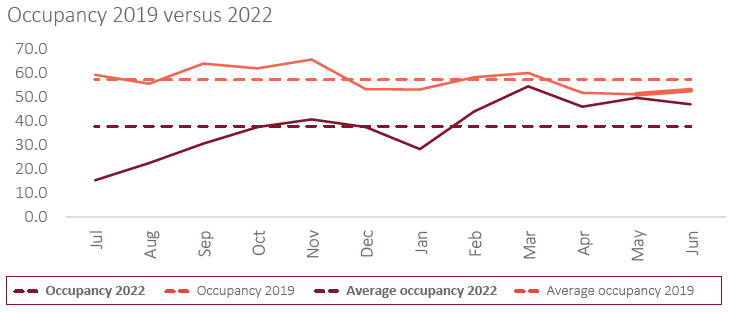
COMPARISONS PRE AND POST PANDEMIC (%)
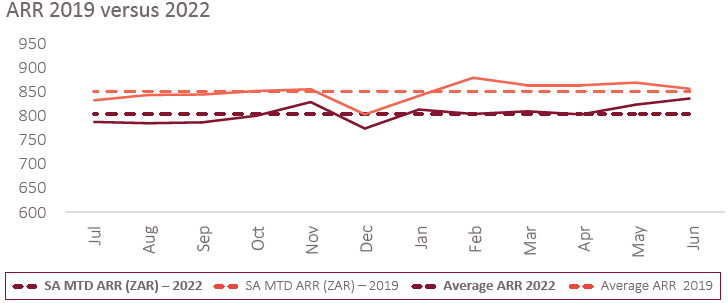
COMPARISONS THREE-YEAR QUARTERLY OCCUPANY AND ARR TREND
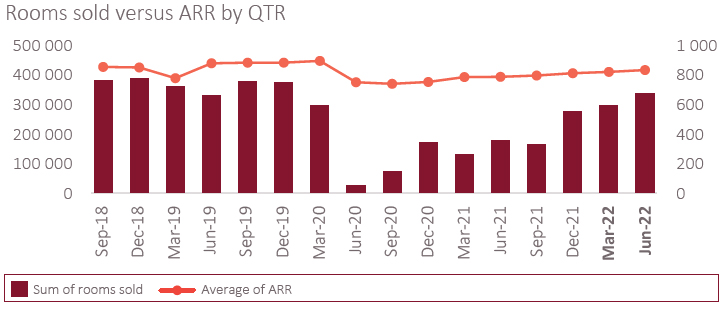
PERFORMANCE FOR THE YEAR
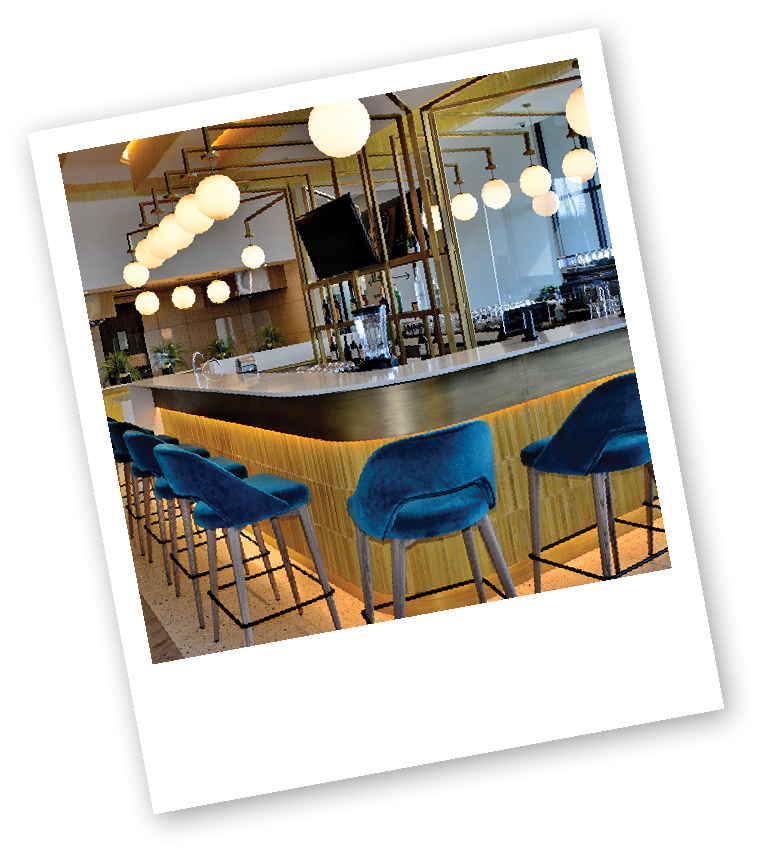
Through all the turmoil and challenges during the twelve months under review the group had a healthy financial performance through increasing revenue by 117% to R1 104 million (2021: R508 million). This included a 150% increase in food and beverage revenue spurred by the exciting developments in our enhanced offering. The improved occupancy, and the reopening of all hotels, enabled the group to ease some of the cost-containment measures put in place during the pandemic.
The group generated EBITDAR for the year of R303.2 million (2021: loss of R136.7 million), and an EBITDAR margin of 27% (2021: EBITDAR loss margin 27%).
The long awaited disposal of the East African operations generated an accounting profit of R88.3 million (representing a recovery of accumulated losses in prior years) from the net proceeds of R468.6 million.
The improved performance following the easing of lockdown restrictions resulted in a profit after tax for the year of R81.7 million (2021: net loss of R804.6 million) and earnings per share of 14.3 cents (2021: loss per share 160.6).
OUTLOOK
Looking ahead, we are mindful that our operating environment will encounter obstacles in the coming year. Rising inflation (impacting both consumers and businesses in profound ways) is going to be a key driver of our occupancy performance. In South Africa, and certainly across the rest of the continent, central banks remain pessimistic about the economic recovery prospects of many economies. There are stronger indications that we might see a continued hike in interest rates.
Despite this challenging context, we remain optimistic that our efforts to stimulate demand will hold us in good stead, as business, leisure and wellness travel continues. The challenges that the group face are just as applicable to our competitors as they are to us and we have an opportunity to position ourselves as an adaptable and incisive player in our industry. Regardless of the outcome, CLHG’s BAR methodology will help to optimise demand and increase occupancy.
