
Integrated Report 2020
We are operating in challenging times. Since the beginning of 2019, several factors were placing pressure on the African and global economy, including the tourism industry, followed by the arrival of the COVID-19 pandemic. The travel and hospitality industry was among those hardest hit. In South Africa, our largest market, the national government responded with a lockdown that brought local and international tourism to a grinding halt. Other African countries, including those in which we operate, soon followed with similar measures.
However, CLHG remains agile and alert. We are proactively monitoring and managing the effects of the operating environment on our business.
Before COVID-19
Prior to the COVID-19 outbreak, our focus was on the macro economy. As South Africa is the group's primary country of operation, with 55 of our 62 hotels operating in the country, it remains our greatest focus area.
At a macro level, South Africa has faced several challenges. The Zondo Commission was investigating corruption that allegedly stretched to the very top of national government, and these investigations are continuing. Intermittent electricity supply due to load shedding also posed challenges. This led to a gross domestic product (GDP) contraction of -0.8% and -1.4% respectively in the third and fourth quarters of 2019, followed by another -2% in the first quarter of 2020. These factors contributed to low business and consumer confidence through the year, which was compounded by the Moody's ratings agency downgrade of South Africa to 'Junk' status in late March. As a business, we were already seeing a decline in our occupancy numbers and average room rates, making trading conditions inauspicious.
CLHG is adept at trading through tough times due to our business model of being a value for money hotel establishment with a variety of one to four-star facilities priced for different classes of traveller. However, we are facing an unprecedented industry landscape now. Good value for money could not protect us from the impacts of the industry shut-down in the initial stages of the pandemic and lockdown.
The impact of the COVID-19 pandemic
The COVID-19 pandemic has significantly impacted the global economy and strained the hospitality industry. Travel restrictions, along with other pandemic containment and mitigation directives, resulted in closed businesses, guest cancellations, and significantly reduced travel around the world. This includes South Africa and the other countries where the Group operates (Botswana, Kenya, Mozambique, Namibia and Tanzania).
 |
In South Africa, a national state of disaster was declared by the government on 15 March 2020. On 23 March 2020, President Cyril Ramaphosa and Health Minister Zweli Mkhize announced strict lockdown protocols commencing on 27 March 2020 to minimise the spread of COVID-19. This included the closure of all shops and businesses. Only essential services could continue operating, such as pharmacies, laboratories, banks, the JSE, supermarkets, petrol stations and healthcare providers. Similar stringent lockdown protocols were implemented shortly thereafter in the other African countries where the group operates. Since the beginning of lockdown measures, South Africa has been on a COVID-19 Risk Adjusted Strategy, which is a gradual phased reopening plan. At the writing of this report, South Africa was on Alert Level 1. The pandemic and associated restrictions has had severe repercussions for the South African tourism industry. |
Total income/(loss) for tourist accommodation and food and beverage industry
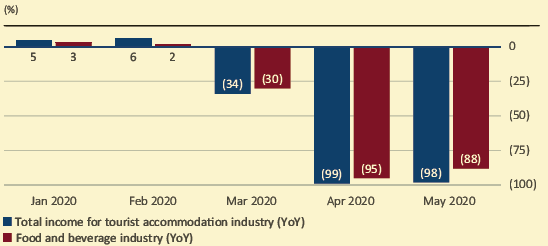
The impact of restrictions on the movement of people and business, also showed up in domestic tourism numbers. Income from accommodation fell 99% during the first full month of the lockdown and has yet to recover. The crash in food and beverage sales began to ease from May as restaurants opened for delivery, followed by limited trading.
At the commencement of lockdown on the 27 March, all of the group's 62 hotels were temporarily closed to the public in accordance with government protocols, though four hotels in South Africa remained open on a limited basis. The open hotels provided support to government authorities and essential and critical business continuity services. They also offered other enabling services in the form of quarantine facilities, staff accommodation and housing for international tourists unable to return to their home countries. Reopened hotels have been operating at reduced 'stay safe' room rates. The group's hotels remain ready and flexible to open at short notice based on guest demand, while ensuring strict adherence to our industry-leading hygiene and safety protocols to ensure the safety and wellbeing of our guests and staff. We have an ongoing phased opening of hotels with the target of 45 hotels open by the end of the calendar year and the remainder in the first quarter of 2021.
We continually review how guests search for accommodation. The current environment poses a challenge, given that guests are rate sensitive, and therefore often trawl the online booking options in order to derive the best possible rate. The competitor set is prone to price wars and, therefore, four and five-star brands are dumping their rates, which poses a challenge for the group to hold rate power. Traditionally known for the best price in the range, but now we are sometimes seen as being less competitive in rates.
We did well in terms of government and corporate business from our online travel sources. The increase in direct bookings from our website gives us a better chance of improving our profit margins.
There were, however, many new market entrants, even in outlying areas. There is certainly an over-supply of hotel rooms in areas such as Sandton, which places the entire industry under pressure.
We are pleased to have grown our food and beverage business. We did this through our #Cafe offering, which has become a significant lunch and dinner offering over and above breakfast. In future we will drive this eat-in aspect as part of a greater emphasis on selling in-house. This strategy unlocks an exceptional opportunity to grow revenue through our own products.
In terms of industry legislation, the South African Tourism Amendment Bill (also known as the Airbnb Bill) has been published and is under public comment. The Airbnb Bill seeks to regulate 'short-term rentals', which include "the renting or leasing on a temporary basis, for reward, of a dwelling or part thereof to a visitor". If passed, the Airbnb Bill would empower South Africa's Tourism Minister to set certain thresholds regarding short-term rentals. CLHG expects that the Airbnb Bill, if passed, will serve to limit and discourage competition from providers of alternative lodging solutions. This will allow the group and other traditional hotel brands to regain market share.
 |
Beyond South Africa Botswana is our oldest external market. Our Botswana Town Lodge is situated close to the airport in Gaborone and serves the domestic corporate market, as well as government. It is a focused Town Lodge brand with superb bed and breakfast, run and operated by a local staff complement. While this Town Lodge performs well from Mondays to Thursdays, its weekend occupancy tends to be lower. Our access to Botswana's corporate market is a strength. |
||
 |
In Windhoek, Namibia, we recently opened a new generation Town Lodge. For guest convenience it is located next to a shopping centre and does what Town Lodge does best: great accommodation and good breakfast. As in Gaborone, our Town Lodge mainly services the corporate market during the week, but fortunately also attracts steady leisure clientele from Namibia's healthy tourism industry. |
||
 |
City Lodge Maputo (in Mozambique) was more challenging to launch than anticipated. After encountering several building and development delays, the hotel opened just as the COVID-19 pandemic spread to Southern Africa. Although this new venue has been slow out of the starting blocks, we foresee its future growth being driven by domestic and international business and leisure travel. |
||
 |
In East Africa, we acquired full ownership of Fairview in Kenya in 2014. It was already well-established and well run. The Kenyans have experienced terrorist attacks in the past, which dulled the tourist industry. However, Fairview is situated opposite the Israeli embassy, which is very secure. This hotel has historically maintained a robust performance, based on its beautiful gardens and traditional appeal. City Lodge Hotel Two Rivers opened in early 2018 mainly servicing the NGOs, embassies and other business travellers in the area. Occupancy performance has been below expectations. |
||
 |
In December 2018, CLHG commenced trading in Tanzania by opening the City Lodge Hotel Dar es Salaam, a newly constructed 148 room hotel in late 2018, featuring the modern touches and convenience that business travellers and tourists require. This air-conditioned, modern hotel is strategically located in Dar es Salaam's Ilala district, which is the country's most significant commercial and governmental hub. Bookings through 2019 were more sluggish than anticipated and COVID-19 temporarily halted all operations in early 2020. Fortunately the Tanzanian government has lifted almost all COVID-19 restrictions and tourism appears to be regaining impetus. |
The African hotel market is fragmented and highly competitive, with the group facing competition from various sources. Firstly, we face competition from other hotel groups in our markets, including various international hotel groups that are exhibiting a growing interest in developing and expanding their respective offerings throughout Africa. Given the comparatively smaller size of the African market to other international travel destinations, increasing over-supply remains a risk. Coupled with the globally uncertain macro-economic landscape, the result is continued pressure on occupancies.
In addition, the rapid development of the digital consumer landscape is an undeniable trend. It has given potential hotel guests immediate access to a wide variety of third-party booking agencies and online travel intermediaries that focus on competitive pricing. Furthermore, alternative lodging solutions, such as peer-to-peer, short-term home rental companies and serviced apartments, have all intensified the competition for travellers in Africa.

